DevSecOps Engineer Job Description: Requirements, Skills and Interview Questions (2026)
At Whitespots we work with security teams every day, and we keep seeing problems that start at the hiring stage: the job description lists scanners and says nothing about who will handle what they find. This template is for CISOs, CTOs, engineering managers, recruiters and security leads who are looking for a DevSecOps engineer. Use it as is or as a checklist for your own job description.
A DevSecOps engineer builds security into the way software gets written, built and shipped. In practice the role sits between three teams: developers who want to ship, operations who own the infrastructure, and security who own the risk. That makes it a complex role that is hard to describe in a single way. Some companies hire a DevOps engineer who knows a few scanners, others hire an application security specialist who can write pipelines, and both end up with a job description that lists every tool in the category.
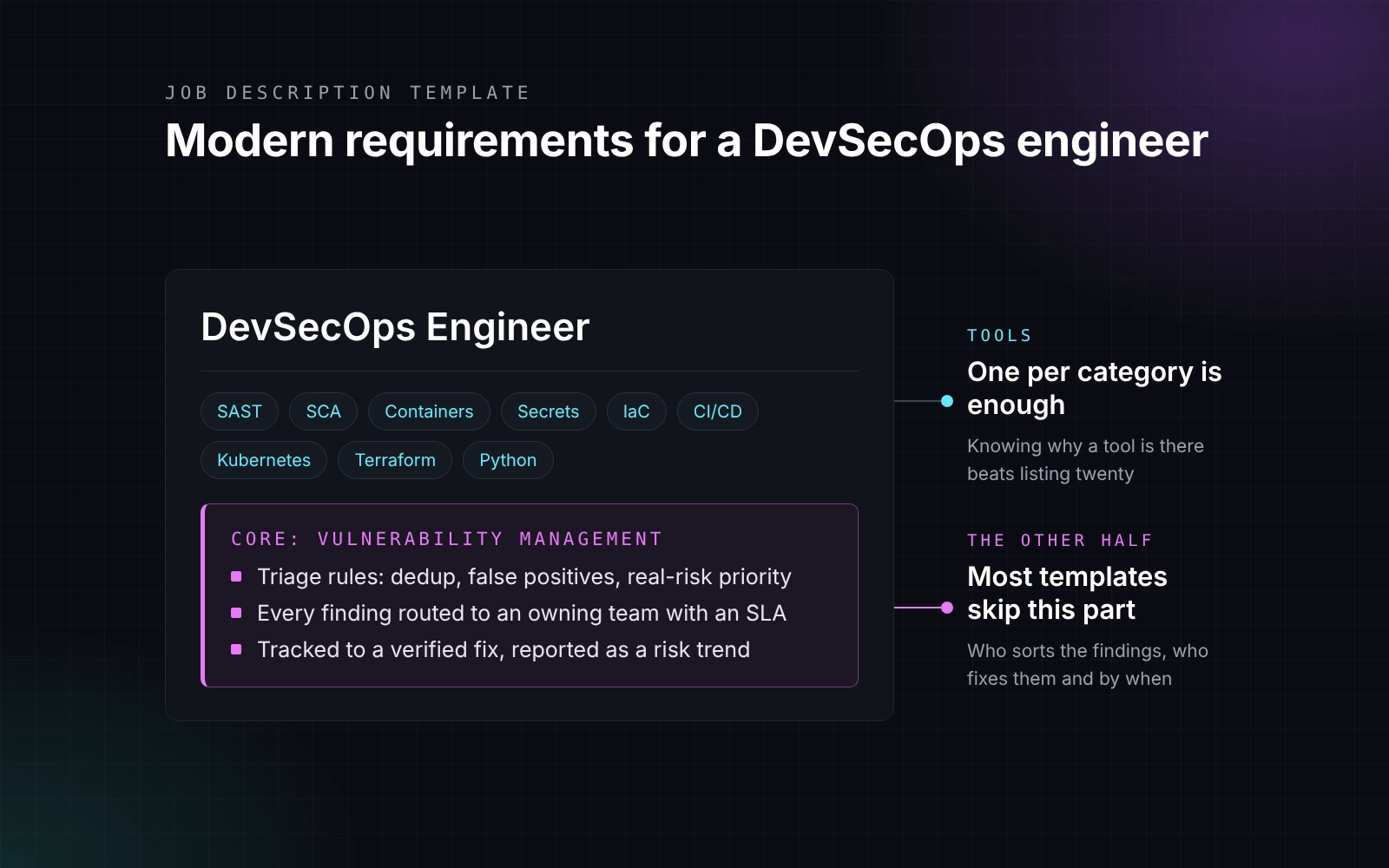
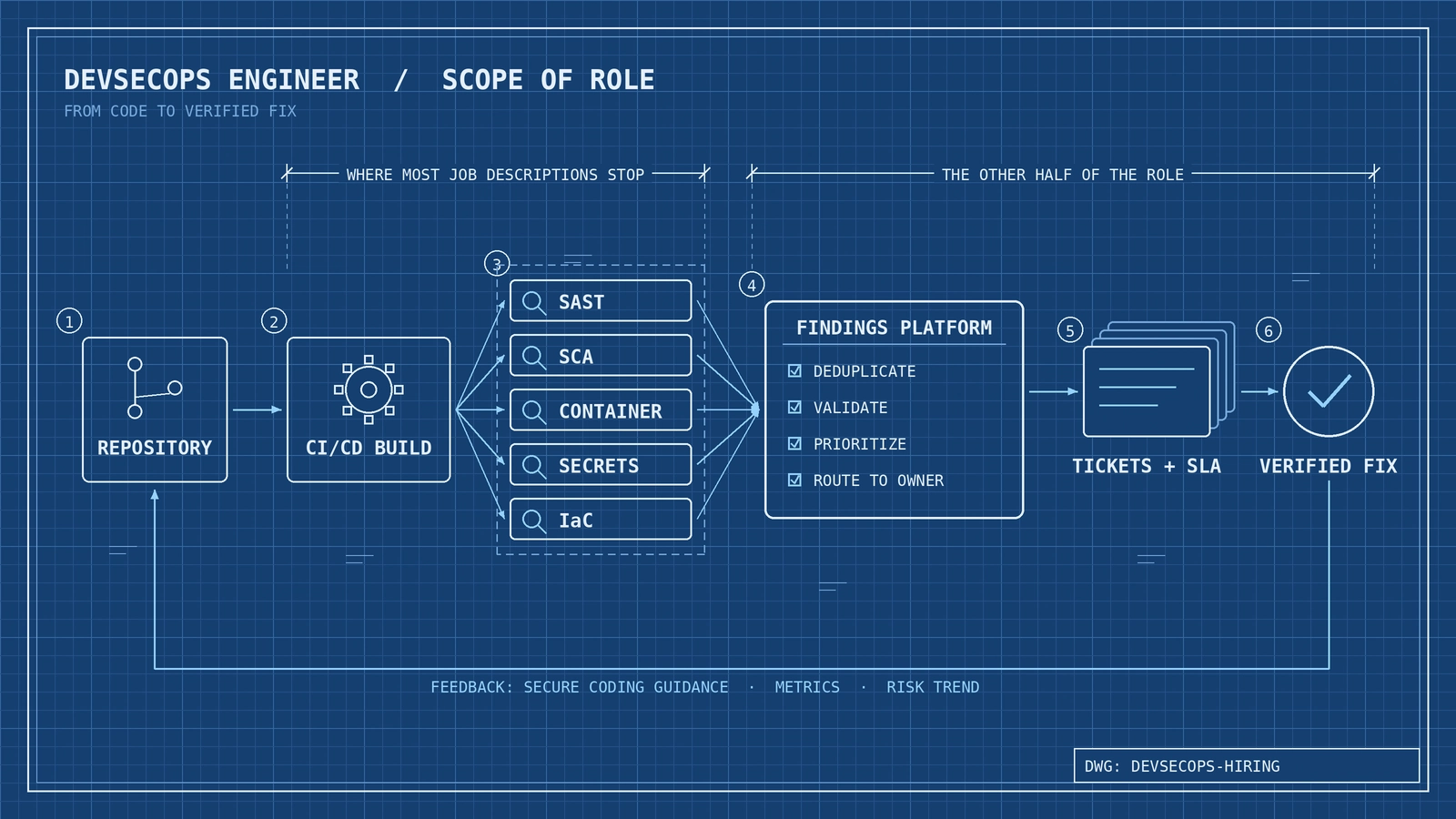
Most published templates stop at the scanners. They describe how to plug SAST, SCA and container scanning into CI/CD and say very little about what happens to the findings afterwards: who sorts them, who fixes them, by when, and how anyone knows the risk is going down. In a mature team that second half takes most of the time. The template below covers both.
Job description template
Copy it, replace the bracketed parts and remove what doesn’t apply.
DevSecOps Engineer at [Company]
[Company] builds [product] for [customers]. Our engineering team of [number] developers ships to production [frequency]. We are looking for a DevSecOps engineer to make security part of that process without slowing it down.
What you will do
- Build and maintain automated security checks for code, dependencies, container images, secrets and infrastructure as code across all of our repositories.
- Run vulnerability management end to end: write triage rules in ASOC (remove duplicates and false positives, prioritize by real risk), route each finding to an owning team and track it to a verified fix.
- Define remediation SLAs by severity together with engineering leads, and report on how well they are met.
- Harden our cloud, Kubernetes and container infrastructure, and manage secrets, IAM and least-privilege access.
- Communicate issues to developers to fix them quickly: create tickets, set up merge request comments, write secure coding guidance and make short training sessions.
- Prepare technical evidence for [ISO 27001 / SOC 2 / PCI DSS / NIS2] audits.
Requirements
- [3+] years in DevOps, SRE, platform or application security roles, including hands-on work with security tooling.
- Experience running security scanners in production: SAST, SCA, container, secrets and IaC scanning.
- Experience with vulnerability management or ASPM platforms (DefectDojo, Whitespots or similar), including validation, deduplication and prioritization rules.
- Working knowledge of CI/CD (GitLab CI, GitHub Actions or Jenkins), Docker and Kubernetes.
- Infrastructure as code with Terraform, Ansible or similar.
- Scripting in Python, Go or Bash for automation and tool integration.
- Understanding of the OWASP Top 10, CVSS and how exploitability and business context change the priority of a finding.
- Ability to explain risk to developers and management in plain terms.
Nice to have
- Experience setting up security processes from scratch across many repositories.
- Supply chain security: SBOMs, image signing, dependency governance.
- Policy as code: OPA/Gatekeeper, Kyverno.
- Experience preparing audit evidence for ISO 27001, SOC 2 or similar frameworks.
- Certifications such as CKS, OSCP or AWS Security Specialty.
What we offer
[Salary range, location or remote policy, benefits.]
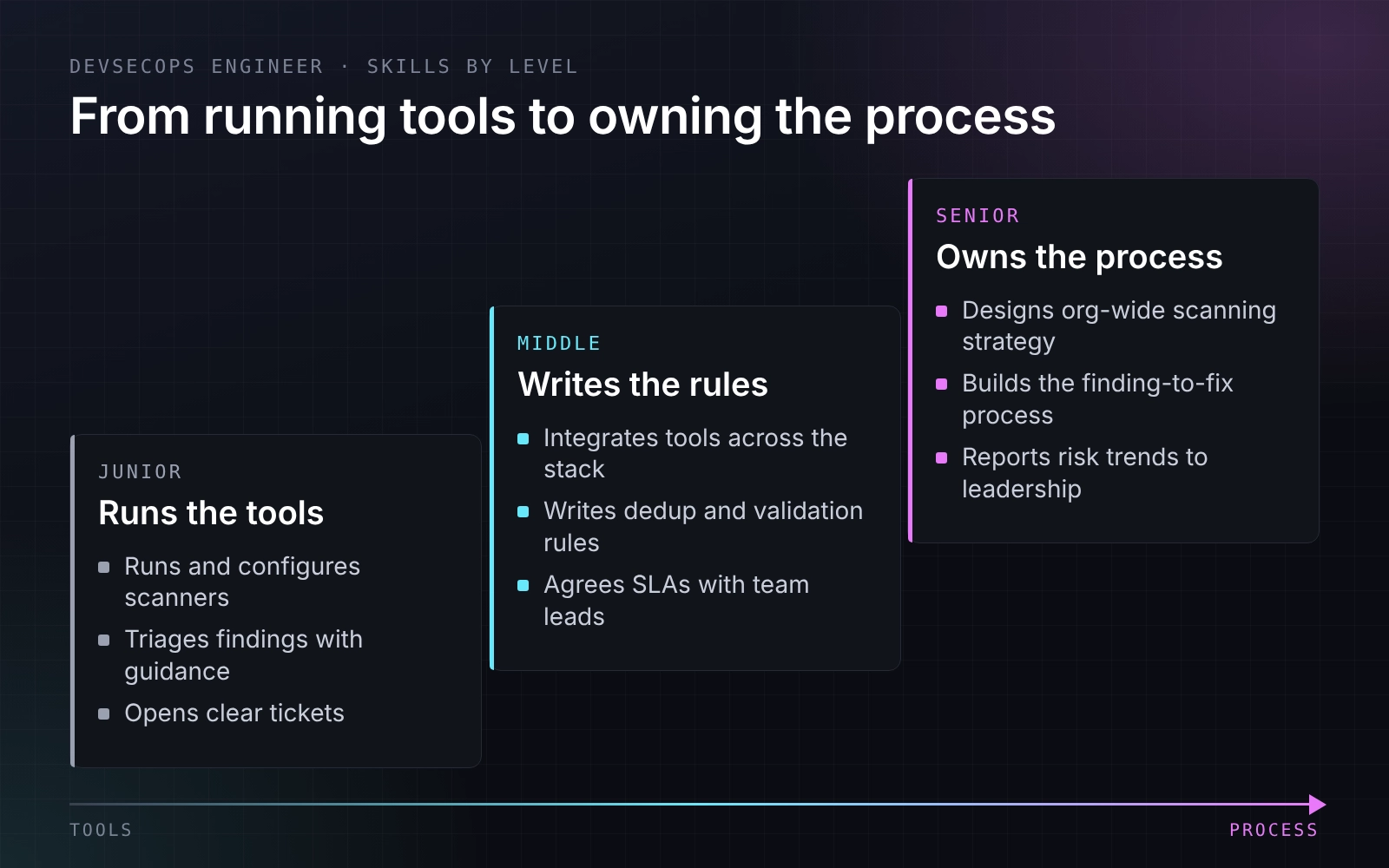
Skills by level
| Junior | Middle | Senior | |
|---|---|---|---|
| Scanners | Runs and configures existing tools | Chooses and integrates tools across the stack | Designs the scanning strategy for the whole organization |
| Findings | Triages findings with guidance | Writes deduplication and validation rules | Builds the process from finding to verified fix |
| Prioritization | Uses a CVSS calculator | Adds exploitability and asset context | Sets risk thresholds with leadership |
| Developers | Opens clear tickets | Agrees SLAs with team leads | Makes security part of how teams plan their work |
| Infrastructure | Follows hardening guides | Hardens Kubernetes and cloud environments | Defines security baselines and guardrails |
| Reporting | Prepares data on request | Tracks remediation metrics | Reports risk trends to management and auditors |
Tool stack by category
A candidate doesn’t need to know every tool listed below. Most likely, someone who knows one tool per category well and understands why it is there will be a better hire than someone who lists twenty.
| Category | What it does | Common tools |
|---|---|---|
| SAST | Finds vulnerabilities in source code | Semgrep, CodeQL, SonarQube |
| SCA | Finds vulnerable open source dependencies | Trivy, OWASP Dependency-Check, Snyk |
| Container scanning | Finds vulnerable packages in images | Trivy, Grype |
| Secrets scanning | Finds credentials committed to code | Gitleaks, TruffleHog |
| IaC scanning | Finds misconfigurations in infrastructure code | Checkov, KICS |
| DAST | Tests running applications | OWASP ZAP, Nuclei, Burp Suite |
| Vulnerability management / ASPM | Collects findings from all scanners, deduplicates, prioritizes and tracks remediation | DefectDojo, Whitespots, OX Security |
| Secrets management | Stores and rotates credentials | HashiCorp Vault, cloud secret managers |
| CI/CD | Builds and ships code | GitLab CI, GitHub Actions, Jenkins |
What separates a strong candidate
Running scanners is the easy part. The hard part starts when they produce thousands of findings a month, several tools report the same issue, and nobody is sure which of them matters. A strong DevSecOps engineer has dealt with that and can describe:
- Coverage. How they made sure every repository gets scanned, including new ones, without adding a CI template to each project by hand.
- Noise reduction. How they removed duplicates across scanners and tuned rules against false positives, and roughly how much noise that removed.
- Prioritization. Why the same CVE can be urgent in one place and irrelevant in another, and which signals they used: exploitability, whether the vulnerable code is reachable, whether the asset runs in production, how critical the service is.
- Ownership. How each finding got an owning team and a deadline, and what happened when the deadline passed.
- Verification. How they confirmed a fix before closing the finding.
Interview questions
Each question comes with what a good answer should cover.
- Your scanners report 3,000 findings this month. What do you do first? Finds patterns, removes duplicates and known false positives by patterns, then prioritizes by exploitability and asset context. Never starts by opening 3,000 tickets.
- Three tools report the same vulnerability. How should that show up for the developer? As one finding and one ticket. Ideally, right in the IDE and as a merge request. Developers don’t visit task trackers as much as IDE. Explains how deduplication across tools works in practice.
- The same CVE with CVSS 9.8 appears in a production payment service and in an unused test image. How do you prioritize them? Different priorities. Mentions environment, reachability and business criticality. These assets should be marked initially to avoid such situations.
- How do you make sure a new repository gets scanned from day one? Organization-level integration, such as webhooks on the VCS group or org-wide policies, rather than relying on each team to add a pipeline step.
- Which metrics would you report to management every month? Mean time to remediate per team, weighted risk trend, SLA compliance, scanning coverage. Raw vulnerability count is a weak answer.
- How do you handle a scanner update that changes results across all repositories? Version pinning, central rollout, comparing results before and after.
- Tell us about a time security slowed down delivery. What did you change? Shows the candidate can work with developers and fix the process, beyond adding more gates.
Red flags
- Lists many tools but can’t describe what happened to the findings they produced.
- Treats CVSS as the only priority signal.
- Measures success by the number of vulnerabilities found.
- Has only added security gates to pipelines and never worked on reducing their noise.
- Can’t name a metric that showed their work reduced risk.
- Does not know the purpose of tools.
- Can’t name 3+ challenges in implementing security through pipelines and considers this the best option.
Metrics to hire for
If you write measurable goals into the role, the candidate knows what success looks like and you know how to evaluate the hire after six months:
- Risk trend against a risk appetite
- Mean time to remediate, by severity and by team
- SLA compliance by severity
- False positive rate after validation rules
FAQ
What is the difference between a DevSecOps engineer and an AppSec engineer? An AppSec engineer focuses on the security of the application itself: code review, threat modeling, penetration testing. A DevSecOps engineer focuses on the process and infrastructure that deliver the application, automating security checks and making sure their results get fixed. In smaller companies one person often does both.
Does a DevSecOps engineer need to know how to code? They need to script well enough to automate checks and integrate tools, usually in Python, Go or Bash. They also need to read code well enough to judge whether a finding is real.
Can we promote a DevOps engineer into this role? Often yes. A DevOps engineer already knows the infrastructure. The gaps to close are vulnerability triage, prioritization and working with developers on fixes.
How many DevSecOps engineers does a company need? It depends mostly on how much of the work is automated. With manual triage, the number of findings grows faster than the team. With automated deduplication, validation and ticket routing, one engineer can cover far more repositories.
Which certifications matter? CKS for Kubernetes security, OSCP for offensive skills, and cloud security certifications such as AWS Security Specialty are common. Hands-on experience with a real backlog of findings matters more than any certificate.
If the engineer you hire will be building vulnerability management from scratch, consider the long-term cost of that decision. Developing such a system is only the beginning. Maintaining it is expensive for any vendor. The complexity of vulnerability management platforms means a constant stream of edge cases, bugs, integrations to maintain, and new features to support.
Established solutions like Whitespots have already gone through countless development and feedback cycles, continuously improving through real-world use. They handle the collection, deduplication, prioritization, and routing of findings, allowing your engineer to focus on decisions that actually require human expertise.
For an organization, the most important thing is process continuity. Vulnerability management must work reliably day after day, not depend on a custom-built system that one engineer has to develop, maintain, and troubleshoot. Buying a mature platform means investing in an established, continuously maintained process rather than creating another product your organization has to own.